


Kopron produced three big motorized warehouses for Enel “E.Montale” in La Spezia – a power station not far from Genoa
Home » Kopron produced three big motorized warehouses for Enel “E.Montale” in La Spezia – a power station not far from Genoa
Sludge and ash tanks were duly covered for safety, optimizing space.
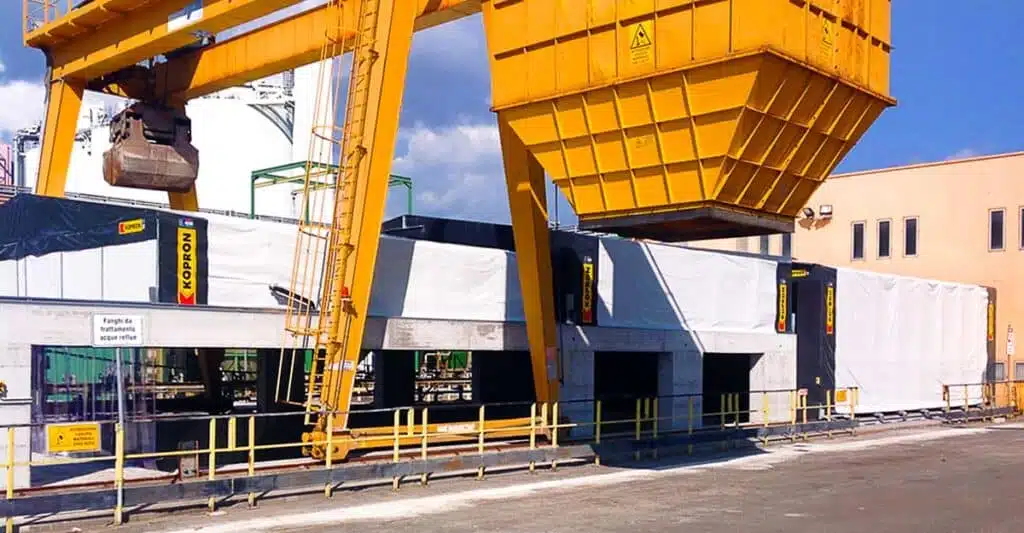
Kopron, well-known leaders in the logistic field mostly specializing in retractable industrial coverings, produced three important motorized warehouses necessary to cover a total area of 350 m² of tanks for sludge and ashes produced by the power station, ready for sewage or disposal.
According to a local ministerial decree these tanks had to be covered, Kopron’s intervention was therefore necessary: they made one motorized retractable warehouse of 150 m², 4 m tall, and two warehouses one fixed and the other which slides on tracks into the other leaving the below part free for about 200 m². This telescopic function enables to empty the tanks from above and cover them again once the operation is over.
The carrying structure consists in hot-dipped galvanized steel tubes connected to one another by means of scissor type bars. Sliding is on wheels in steel with watertight double ball-bearings, hosted in a Kopron patented casing, provided with windproof and anti-derailment devices.
Kopron was the only company able to bid for the tender offering a unique solution. Kopron’s Technical dpt worked out a solution especially tailored to customer’s needs.
Come primo riferimento, nel 2026 il costo può partire indicativamente da 90-120 €/m² per configurazioni più semplici, arrivare a 120-250 €/m² per capannoni industriali completi e superare 300 €/m² per soluzioni personalizzate o con particolari esigenze di coibentazione.
Non sempre. Per strutture realmente temporanee possono essere previsti regimi autorizzativi semplificati. Se invece il capannone è destinato a un utilizzo stabile, può essere necessario il permesso di costruire. La semplice possibilità di smontarlo non determina automaticamente l’esenzione: il titolo edilizio va verificato in base al progetto e alla normativa locale.
Non sempre. A seconda della struttura e del terreno, l’ancoraggio può avvenire su pavimentazione industriale esistente, oppure richiedere plinti in calcestruzzo, cordoli/travi di fondazione o platee. La soluzione viene definita in fase di progettazione in base ai carichi, alle caratteristiche del sito e ai calcoli strutturali.
L’Arch. Giovanna Comi, head architect, said:
‘Creating the design for Enel required a proper valuation of the sizes – there were limits in height and an overhead crane to avoid to interfere with. Really, quite a challenge, but in the end we made it!’.